Does what it's meant to.
Nothing else.
Your groups, channels and stations in one place. Open a thread and the last 30 days are there, already heard.
See what friends are playing on Spotify and press play to hear it with them, in sync. Works Telegotchi to Telegotchi, both ways.
Say what, when and who. Friends answer with a thumbs up, a reply or a poll vote. Yes sets reminders the evening before and an hour before.
Sleep sounds and guided meditations, on the phone, no stream. A sleep timer: 30 minutes, 45, or an hour.
One tap and anyone you know can talk straight into your ear: their voice notes play the moment they land. Strangers never do.
An always-open line with one person. A split atom that joins when they say yes. Either side can untangle.
Friends on ordinary Telegram see every invite as a small card with your sigil, not a line of code. They answer with a voice note.
Tap a place someone sent you for directions, on offline maps. Links open inside the phone.
Hold the button and talk, even when the phone is locked. With a home server, memos become notes and actions.
Telegotchi's own PIN lock. From switch-on to switch-off you never leave the Telegotchi screen.
No Google services on the phone. Apps come from open-source stores only.
Find other Telegotchis close by over Bluetooth. You have to be visible to see anyone, and only a username is swapped, never a number.
ComingEmail, WhatsApp, calendar and agents live on the home server.
Two ways to reach people. In order of privacy.
MESH — first choice: Telegotchi to Telegotchi over LoRa radio. No internet. No server. No company. Your message travels through the air and arrives. Nothing stored anywhere.
SIGNAL ENCRYPTION — for everyone else: The same encryption standard used by Signal. End-to-end. Keys generated on your devices. Nobody can read it except you and them. Not us. Not any server. Not anyone.
Your contacts are already there. Everyone from your address book. Send a message. It arrives encrypted. If they are not set up yet — they get an invitation to be.
Pull from everywhere. Your phone. Your existing accounts. Every person you already know appears in one place.
First time you message someone who is not yet set up — they get a prompt. One tap. Two minutes. Done.
From that point — fully encrypted. Always. Without thinking about it.
Per-contact toggle. When it is on, their voice notes auto-play the moment they arrive. No tap required. No unlock. No checking.
Like a walkie-talkie that is always open between you.
Either side can close it. Persistent across sessions. The most intimate communication feature we have ever seen on any device — and nobody had to build a social network to make it work.
Invite-based. Both sides agree before anything is shared. Real-time location on the map. No route history stored. Either side ends it instantly. Trusted contacts only.
You know where they are. They know where you are. The moment either of you decides otherwise, it stops. No data retained. No history. No trail.
For parents. For couples. For friends at a festival when the signal is gone and the mesh puck takes over.
Press the button. Say it. Done.
Reminders. Notes. Questions answered. Morning brief. Navigation. Email summaries.
Everything your phone managed. Running at home, on hardware you own. Nothing leaving your network. Not a lesser version. A better architecture.
OsmAnd off-grid maps — no Google, no tracking, works without internet. Google Maps tab available in a sandboxed environment for when you need it.
Save and find places by voice. AI geocoding. Live proximity sharing with trusted contacts overlaid on the map in real time.
The map that works when the network doesn't.
No camera. No fingerprint scanner. No NFC. No ambient LED.
Voice converted to text on the device — locally, privately, before anything else happens. Audio is discarded immediately. It never leaves. No cloud voice processing of any kind.
Software loaded directly onto the device — nothing from an app store, nothing that can be updated without your knowledge. Crypto payment accepted. No KYC.
This is not a privacy policy. It is an architecture. The difference is that one can be changed by a legal team on a Tuesday afternoon. The other cannot. Full privacy page →
LoRa is a radio frequency. Like FM. Like WiFi. Except it travels kilometres, passes through walls, and costs almost nothing in battery. It is built into the device. Not an accessory. The antenna is a copper trace etched into the back panel. Always there. One tap.
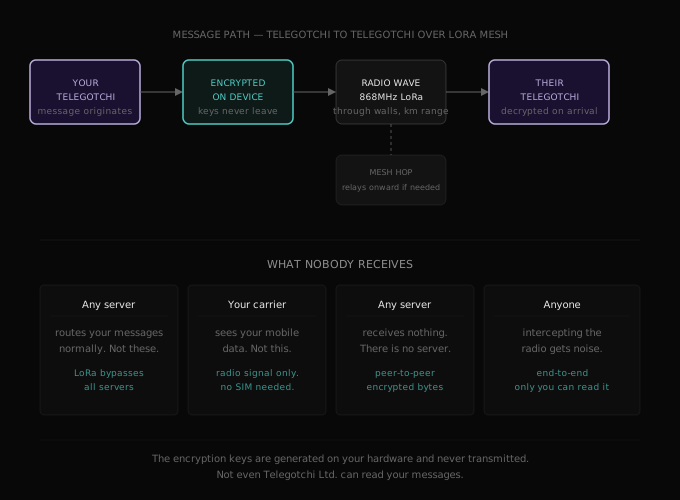
What travels between devices. What nobody receives.
The encryption lives on your hardware, not on any server.
Berlin. Amsterdam. New York. London. Tokyo. The mesh already exists in your city. If it does not — every Telegotchi makes it denser.
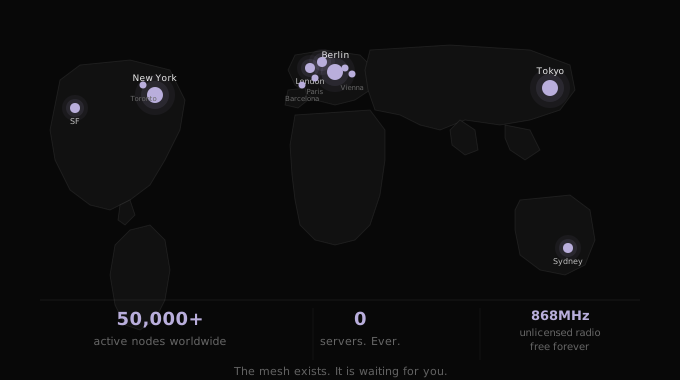
The mesh already exists in your city.
If it does not — every Telegotchi makes it denser.
Festivals. Protests. Disaster zones. Mountains. At sea. Underground. Countries that turned the internet off.
It finds a way. Full mesh page →
No scroll. No feed. No inbox. No keyboard required.
Voice first — the interface is the button. Spotify by voice. Navigation sounds on screen transitions. A bloom tone on incoming and outgoing voice notes. A drone and voice greeting on welcome.
Bottom navigation: Chat · Map · Music
Nothing asking for your attention. Everything responding to your voice.
The mesh is private by default.
One tap and you appear on it. A dot on the map. A position. A message. Nothing else.
Turn it off and you are gone. No trace. No history.
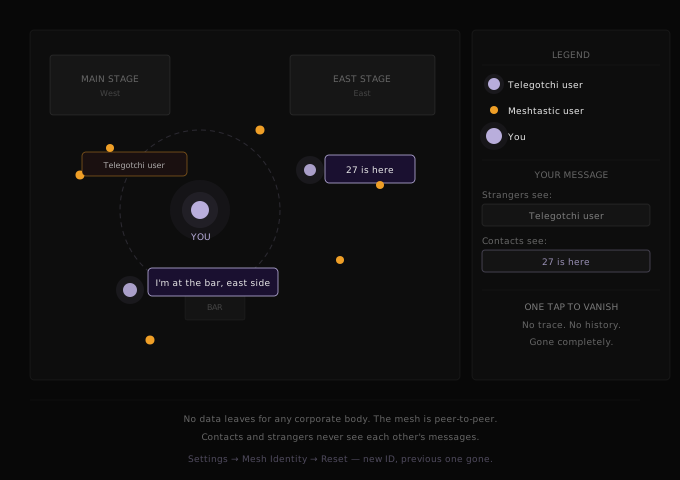
Strangers see one message. Your contacts see another.
You set both. You can change them any time.
Turn Explore off and you disappear completely.
WHAT STRANGERS SEE
You set this. Maybe "Telegotchi user". Maybe nothing at all. 39 characters max. No name required. No identity.
WHAT YOUR CONTACTS SEE
Different message. Your choice entirely. "27 is here". "I'm near the east stage". Set it before you go. Change it whenever you want.
Settings → Mesh Identity → Reset — new node ID, previous one gone. No link between past and future appearances.
There was something radio gave you that nobody had a word for at the time.
You were alone in your bedroom. Or driving. Or doing something that needed your hands but not your mind. And a song came on.
Not a song you chose. A song that arrived.
And somewhere in the middle of it — the build, the drop, the moment the key changes and something in your chest does too — you knew, without knowing how you knew, that someone else was feeling this at exactly this second.
Not later. Not when they got around to it. Now. The same bar. The same breath. A stranger in a car three streets over. Someone's mother in a kitchen forty miles away. Whoever was on the night shift. Whoever couldn't sleep.
All of you. At once. The same sadness. The same lift. The same skin.
That was radio. Not the technology. The fact of simultaneity. The invisible thread that runs between people experiencing the same thing at the same moment.
Streaming cut the thread.
It gave you everything you wanted, on demand, perfectly curated, completely alone.
Fifty million songs. All of them yours. None of them shared.
You can listen to the same song as someone you love and be a thousand miles apart and start it at different times and finish it at different times and never once be in the same moment.
The song is the same.
The experience is not.
The people you love are carrying a radio.
When they put something on — when they find the song that matches the exact colour of how they feel right now — you see it.
A name. An album cover. Three words.
And you tap it.
And now you are in it together. The same bar. The same breath. The same build toward the same moment you both feel in the same part of your chest.
They do not know you just joined. You do not need to tell them. That is not the point.
The point is that somewhere, right now, the person you love is feeling something — and you are feeling it with them.
Not later. Not approximately. Now.
A tiny radio station that only you can tune into. Broadcasting from wherever they are. Received wherever you are.
The thread is back.Connect Spotify.
See what the people you love are hearing.
Tap to be in it with them.
No announcement. No notification sent to them.
Just two people. The same moment.
The same song.
The intimacy of radio.
For the ones you choose.
Requires Spotify. Both sides opt in.
They share what they are hearing.
You tap to play the same track on your Spotify.
No audio is streamed between devices.
Spotify Premium required for playback control.
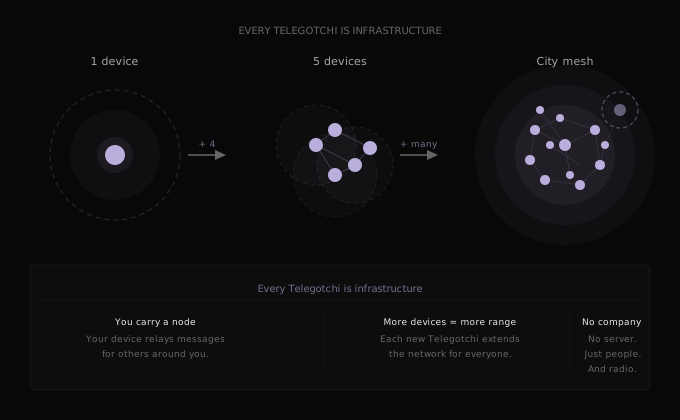
Every Telegotchi relays messages for every other device nearby.
You are not just a user on a network. You are part of the network.
In a city of twenty Telegotchi users, twenty nodes cover ground no single device could. Messages route around obstacles, find gaps, take the long way around.
The mesh gets stronger with every device. No company benefits from this. No server tracks it. The value accrues entirely to the people on it.